
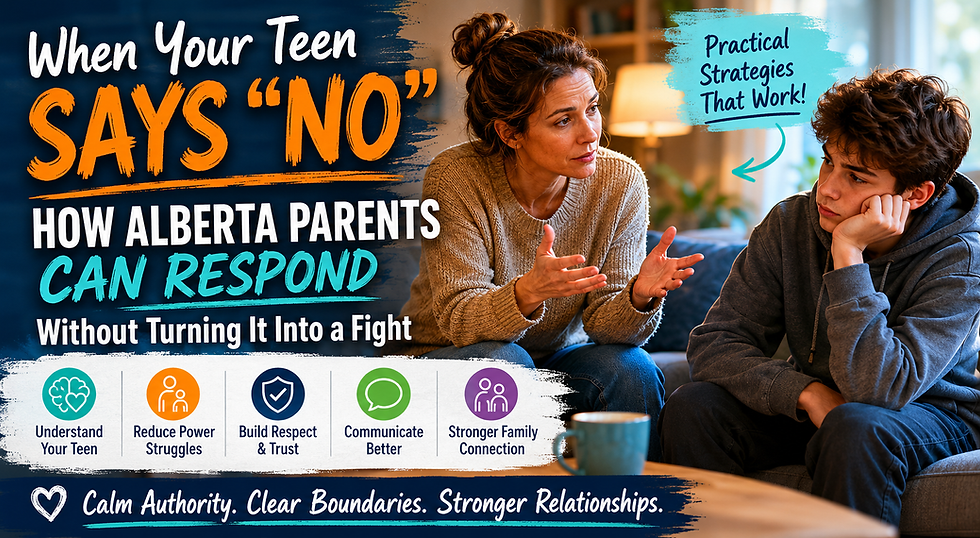
When Your Teen Says “No”: How Alberta Parents Can Respond Without Turning It Into a Fight

You ask your teen to do something simple.
Put the phone away. Start the homework. Load the dishwasher. Get ready for school. Be home on time.
Then they look at you and say one word:
“No.”
For many parents, that one word can feel like disrespect, laziness, defiance, or a total loss of authority.
So the natural reaction is to push harder.
You repeat yourself. You raise your voice. You lecture. You threaten consequences. You explain why they are wrong. You try to win the moment.
But somehow, the harder you push, the more your teen digs in.
This is one of the most common patterns parents run into during the teen years. Whether you live in Edmonton, Calgary, Red Deer, Lethbridge, Grande Prairie, Fort McMurray, Medicine Hat, Sherwood Park, St. Albert, Spruce Grove, Leduc, Airdrie, Camrose, Wetaskiwin, Lloydminster, or a smaller Alberta community, the pattern often looks the same:
A parent asks for cooperation. The teen pushes back. The parent gets frustrated. The teen gets defensive. And suddenly, the original issue is no longer the issue.
Now it is a fight about respect, control, attitude, and authority.
Your Teen’s “No” Is Not Always What It Seems
When a teen refuses to listen, it can feel deeply personal.
Parents often think:
“Why are they being so disrespectful?” “Why can they listen to teachers, coaches, and friends, but not me?” “Why does every little thing have to become a fight?” “Why won’t they just do what needs to be done?”
But with teenagers, the refusal is not always about the task itself.
Sometimes your teen is not really saying:
“I refuse to do the dishwasher.”
They may be saying:
“I don’t want to feel controlled.” “I want to be treated like I’m growing up.” “I need some say in my life.” “I’m overwhelmed and don’t know how to explain it.” “I feel criticized before I even start.” “I don’t want to feel like a little kid.”
This does not mean parents should let everything go. It does not mean teens should be allowed to ignore responsibilities. It means the way the parent responds matters.
Because if the conversation becomes a battle for control, the teen may focus more on protecting their independence than solving the actual problem.
Why Teens Push Back Against Parents
Adolescence is the stage of life where young people are trying to answer a huge internal question:
“Am I still a kid, or am I becoming an adult?”
That question is underneath a lot of teen behaviour.
So when a parent gives a direct command, the teen may not just hear the request. They may hear a challenge to their independence.
The parent says:
“Go do your homework.”
The teen hears:
“You don’t trust me.” “You still see me as a child.” “You think I can’t manage myself.” “You’re controlling me.”
That is why the reaction can feel so much bigger than the situation calls for.
The issue may look like homework, chores, screens, bedtime, school attendance, or attitude. But underneath, it is often about autonomy, respect, responsibility, and identity.
This is where many parents accidentally get pulled into a trap.
They try to regain control by becoming louder, stricter, or more forceful. But the more controlled the teen feels, the more they often resist.
Reactive Control vs. Calm Authority
There is a major difference between reactive control and calm authority.
Reactive control sounds like:
“Do it right now or you lose your phone.” “I’m done with your attitude.” “You don’t get to talk to me like that.” “You’re grounded if this isn’t done immediately.” “Why do I always have to fight with you?”
Most parents use reactive control because they are exhausted. They are not trying to damage the relationship. They are trying to get through the day.
But reactive control often turns the situation into a contest.
Who has more power? Who will back down first? Who gets the last word?
Calm authority is different.
Calm authority sounds like:
“I’m not going to fight with you about this.” “I want to understand what’s making this hard.” “You are allowed to have your feelings about it.” “This still needs to get done.” “Let’s figure out the next step.”
Calm authority does not mean weakness.
It means the parent stays steady.
You are not begging. You are not exploding. You are not giving up the boundary. You are not trying to overpower your teen emotionally.
You are leading.
The Goal Is Not to Win the Moment
A lot of parent-teen conflict escalates because the parent understandably wants the behaviour fixed right now.
The homework needs to be done tonight. The phone needs to be put away now. The chores need to be finished before guests arrive. The teen needs to stop being rude immediately.
That urgency is real.
But the long-term goal is bigger than getting one task done.
The long-term goal is to raise a young adult who can manage responsibility, handle expectations, tolerate frustration, and make decent choices when no one is standing over them.
That does not happen through constant power struggles.
It happens when teens experience a mix of freedom and structure, respect and limits, autonomy and accountability, warmth and follow-through.
This is the core of calm authority.
A Three-Step Response When Your Teen Says “No”
Here is a practical response parents can use the next time their teen refuses a request.
Step 1: Pause Before Reacting
The first move is to slow the conversation down.
Instead of immediately pushing harder, try:
“Let’s pause for a second.” “I’m not going to fight with you.” “Let’s talk this through.” “I can see this is turning into a battle. Let’s slow it down.”
This matters because emotional escalation spreads quickly.
If your teen gets sharp and you get sharper, the conversation can become about tone, attitude, and disrespect instead of the original issue.
Pausing does not mean you are letting them win.
It means you are setting the emotional temperature.
You are showing that you can stay grounded even when your teen is frustrated, defensive, dismissive, or overwhelmed.
Step 2: Acknowledge Their Autonomy
This is the part many parents resist.
You might say:
“You are allowed to make your own choices.” “I get that you don’t want to do this right now.” “I know you don’t like being told what to do.” “I understand that you want more control over your time.” “I’m not here to treat you like a little kid.”
Some parents worry that this gives away their authority.
It does not.
It gives the teen something they are developmentally hungry for: respect.
A teenager who feels respected is often more willing to listen than a teenager who feels cornered.
Acknowledging autonomy does not mean there are no consequences. It does not mean the teen runs the house. It simply means you are recognizing that your teen is becoming their own person.
That recognition can lower defensiveness.
Step 3: Hold the Boundary Clearly
After you pause and acknowledge their autonomy, the boundary still matters.
You might say:
“This still needs to get done.” “The phone still needs to be away by 10.”“The homework still matters.” “You still need to speak respectfully.” “You still need to be home at the time we agreed on.”
The difference is tone.
You are not debating. You are not begging. You are not threatening from anger. You are calmly stating the standard.
A strong version might sound like:
“I understand you don’t want to do it right now. You are allowed to feel that way. At the same time, this still needs to be done. Let’s figure out what is getting in the way.”
That is calm authority.
It combines respect with structure.
Example: When Your Teen Refuses Homework
Let’s say your teen says:
“I’m not doing it.”
A reactive response might be:
“You are doing it right now or I’m taking your phone for the week.”
That may work in the moment, but it can also trigger a fight.
A calm authority response might be:
“I’m not going to fight with you about it. Help me understand what’s making it hard to start.”
Then listen.
Maybe they are overwhelmed. Maybe they do not understand the assignment. Maybe they are embarrassed that they are behind. Maybe they are tired. Maybe they are anxious. Maybe they have already decided they are going to fail, so avoiding the work feels safer than trying.
After you understand more, you can still hold the expectation:
“Thanks for explaining that. I get why it feels hard to start. The assignment still needs attention tonight. Let’s break it into the first 15 minutes and go from there.”
That response gives your teen dignity without removing responsibility.
Example: When Your Teen Refuses to Put the Phone Away
Phone conflict is one of the biggest issues for modern families.
A parent says:
“Put your phone away.”
The teen says:
“No, I’m talking to someone.”
The parent says:
“I don’t care. Put it away now.”
The teen fires back.
Now the fight begins.
A calmer response could be:
“I get that it feels important to finish what you’re doing. I’m not trying to cut you off from your whole life. At the same time, we agreed phones are away at this time. You can take two minutes to finish the message, and then it goes away.”
This is not permissive.
It is structured.
The parent keeps the limit but avoids making the teen feel humiliated or powerless.
Example: When Your Teen Refuses Chores
A teen who refuses chores may not care deeply about the dishwasher. They may care about being interrupted, criticized, or ordered around.
Instead of:
“You never help around here.”
Try:
“I know you don’t want to do it right now. It still needs to happen because everyone in this house contributes. Do you want to do it before supper or after supper?”
That gives limited choice inside a clear boundary.
The teen does not get to opt out of contribution. But they do get some control over how they meet the expectation.
Why This Works Better Over Time
Calm authority does not magically remove all pushback.
Teens will still test limits. They will still have bad days. They will still roll their eyes sometimes. They will still make poor choices sometimes.
But over time, calm authority changes the pattern.
The home becomes less reactive. The teen feels less controlled. The parent feels less desperate. The relationship becomes more stable. Conversations become less explosive.
A teen is more likely to listen to adults who are steady, clear, and consistent.
Think about the adults many teens respect: a good coach, teacher, mentor, employer, or counsellor.
The best ones usually do not need to yell all the time.
They stay calm. They set expectations. They follow through. They do not turn every mistake into a character attack.
That is the kind of authority many teens respond to best.
Calm Authority Is Not Soft Parenting
Some parents hear this and think:
“If I stop being forceful, my teen will walk all over me.”
That fear makes sense, especially if the home has already become chaotic or disrespectful.
But calm authority is not passive.
Passive parenting says:
“Fine, do whatever you want.”
Reactive control says:
“You’ll do it because I said so.”
Calm authority says:
“I respect that you have your own thoughts and feelings. I’m still the parent, and this boundary still matters.”
That is the balance many teens need.
They need to know they are not being controlled like small children, but they also need to know the adults in their life are strong enough to hold limits.
When Teen Defiance May Be a Sign of Something Deeper
Sometimes teen pushback is normal adolescence.
Other times, it may be connected to something deeper.
Parents may want extra support if their teen is also dealing with:
Ongoing school refusal Frequent anger or blowup, isIsolation from family Loss of motivation Heavy screen dependence Anxiety around school or performance Low mood Constant conflict at home Difficulty accepting limits Family communication breakdown Sudden changes in behaviour Parent-child disconnection...
In these cases, the issue is often not solved by finding the perfect consequence.
The family may need a better communication pattern, a better understanding of what the teen is experiencing, and a more effective way to rebuild trust and responsibility.
That is where teen counselling can help.
Online Teen Counselling Across Alberta
Alberta Teen Counselling provides online counselling support for teens and parents across Alberta.
Because sessions are online, families do not need to live in downtown Edmonton or Calgary to access support. Counselling may be available to families in Edmonton, Calgary, Red Deer, Lethbridge, Medicine Hat, Grande Prairie, Fort McMurray, Airdrie, Sherwood Park, St. Albert, Spruce Grove, Leduc, Beaumont, Fort Saskatchewan, Stony Plain, Cochrane, Okotoks, Chestermere, Camrose, Wetaskiwin, Lloydminster, Sylvan Lake, Lacombe, Ponoka, Olds, Didsbury, Drumheller, High River, Strathmore, Brooks, Taber, Vegreville, Vermilion, Whitecourt, Hinton, Edson, Athabasca, Morinville, Redwater, Gibbons, and other Alberta communities.
For parents in smaller towns, online teen counselling can be especially helpful because local options may be limited, waitlists may be long, or your teen may not want to be seen walking into a local office.
Online counselling gives families a private, practical way to get support from home.
Support for Parents and Teens
Teen counselling is not about blaming parents or blaming teens.
Most families are not struggling because nobody cares.
They are struggling because the same conflict pattern keeps repeating.
The parent feels ignored. The teen feels controlled. The parent pushes harder. The teen pushes back harder. Everyone ends up frustrated.
Counselling can help slow that pattern down and make sense of what is happening underneath.
For teens, counselling can help with emotional regulation, motivation, school stress, anxiety, confidence, family conflict, responsibility, and decision-making.
For parents, counselling can help with communication, boundaries, consequences, expectations, and understanding how to respond when your teen shuts down, argues, avoids, or refuses.
Final Thought for Alberta Parents
When your teen says “no,” it does not always mean you have lost control.
It may mean your teen is trying to feel more grown up, more respected, or more in charge of their own life.
Your job is not to crush that independence.
Your job is to guide it.
Calm authority allows you to stay connected while still holding the line.
You can respect your teen’s growing independence and still expect responsibility. You can listen without giving in. You can hold boundaries without turning every issue into a fight.
The goal is not just to raise a teenager who obeys when watched.
The goal is to help raise a young adult who can manage responsibility, handle pressure, and make better choices when no one is standing over them.
Looking for Teen Counselling in Alberta?
If your teen is refusing schoolwork, constantly arguing, shutting down, pushing limits, or turning everyday requests into power struggles, Alberta Teen Counselling can help.
Online counselling is available for teens and families across Alberta, including Edmonton, Calgary, Red Deer, Lethbridge, Medicine Hat, Grande Prairie, Fort McMurray, Sherwood Park, St. Albert, Spruce Grove, Leduc, Airdrie, Camrose, Wetaskiwin, Lloydminster, and many smaller Alberta communities.
Reach out today to learn more about online teen counselling and parent support in Alberta.


Comments